
The Art of the Structured Leather Handbag: Box Calf Leather, Shape & Italian Design

There is an unmistakable elegance to a beautifully structured leather handbag. Its appeal begins with proportion: the curve of a flap, the precision of a handle, the subtle gleam of polished hardware, and the way a carefully constructed silhouette maintains its shape. Unlike softer bags that follow the movement of their contents, a structured handbag establishes its own form, becoming an integral part of the overall look.
Few materials complement this approach quite like smooth Italian leather. With its rich surface, subtle natural characteristics, and ability to be shaped into clean architectural lines, leather brings warmth and depth to even the most restrained designs.
The structured handbag also occupies a fascinating place in fashion history. From elegant mid-century top-handle bags to today's compact leather satchels, its defining qualities remain remarkably consistent: balanced proportions, precise construction, beautiful materials, and practical organization.
But what makes a structured leather handbag different? And how do the type of leather, tanning process, construction, and finishing techniques influence its appearance and performance?
Understanding these details reveals why the finest handbags are appreciated not simply as accessories, but as examples of skilled leatherworking and considered design.
The Enduring Appeal of the Structured Handbag
A structured handbag is designed to retain a recognizable silhouette rather than collapse into a soft, unstructured form.
Its construction may incorporate shaped leather panels, carefully positioned seams, reinforcements, or a frame-like arrangement of components.
The result is a bag with defined proportions and a more architectural appearance.
Structured handbags have appeared in many forms throughout fashion history, particularly in the twentieth century, when compact top-handle designs became closely associated with tailored dressing.
Today, these silhouettes continue to complement a wide variety of clothing, from sharply cut jackets and trousers to simple dresses, denim, and knitwear.
Their visual appeal comes from the relationship between shape and material. A smooth leather surface emphasizes the bag's contours, while carefully selected hardware introduces a contrasting metallic detail.
What Is Box Calf Leather?
Box calf is a term traditionally associated with fine calfskin leather used in leather goods, particularly footwear and structured accessories.
It is generally recognized for its smooth grain surface and refined appearance.
However, the term box calf does not identify one universal tanning recipe or surface treatment. Characteristics can vary between leather producers, finishing methods, and individual products.
Calfskin refers to leather obtained from the hides of young cattle. It is often valued for its relatively fine grain and ability to produce smooth surfaces.
When selected and finished for structured leather goods, calfskin can create an attractive balance between refined appearance and the support required for a defined silhouette.
Quality depends not only on the leather type, but also on the selection of hides, tanning, finishing, cutting, and construction.
Box-Smooth Leather vs. Pebbled Leather
The surface of leather has a considerable influence on the appearance of a handbag.
Smooth leather emphasizes uninterrupted lines and subtle reflections. Because the surface is relatively even, the shape of the handbag becomes especially prominent.
Pebbled leather has a more pronounced grain texture, either naturally occurring or produced through finishing and embossing techniques.
This texture changes how light interacts with the bag and may make certain minor surface marks less noticeable.
Smooth leather, by contrast, can reveal scratches and handling marks more readily, depending on its protective finish.
Neither surface is automatically superior. The choice depends on the appearance, texture, and care characteristics preferred by the wearer.
For structured handbags, smooth leather is especially appealing because it emphasizes the design's precise silhouette and carefully shaped panels.
The Role of Vegetable Tanning in Italian Leather
Vegetable tanning is a traditional method of transforming animal hides into leather using tannins derived from plant materials.
These tannins may come from bark, wood, leaves, or other botanical sources.
The tanning process stabilizes the collagen structure of the hide, producing leather suitable for manufacturing a wide variety of goods.
Vegetable-tanned leather is often appreciated for its character, workability, and ability to develop changes in surface color and appearance through use.
However, the finished properties depend on the particular tanning recipe, the hide, and any additional treatments or coatings.
Vegetable tanning should not be confused with a guarantee that a leather product is untreated, environmentally harmless, or maintenance-free.
The Armonia handbag, featured later in this article, is made from vegetable-tanned box-smooth calfskin leather, bringing together this established leatherworking method and a highly structured design.
What Is Leather Patina?
Patina refers to changes in a leather surface that develop through handling, exposure to light, moisture, oils, and ordinary wear.
Depending on the leather and its finish, these changes may include subtle darkening, variations in sheen, and shifts in color.
Some leathers develop a visible patina more readily than others.
Vegetable-tanned leathers are often associated with this process, although the extent of change depends on the type of finish, color, and conditions of use.
Patina is not the same as damage. Nevertheless, scratches, stains, and excessive exposure to moisture should not automatically be regarded as desirable aging.
Proper leather care helps preserve the material while allowing its appearance to evolve naturally.
Why Italian Leatherworking Is So Highly Regarded
Italy has a long history of leather production, with established manufacturing traditions in regions such as Tuscany.
The region is known for leather processing, cutting, stitching, finishing, and the production of accessories, footwear, and other leather goods.
These activities involve specialized knowledge of how different leathers respond to shaping, assembly, and finishing.
The quality of a finished handbag depends on several individual operations.
Leather panels must be cut accurately, seams aligned, edges finished, and hardware attached securely.
Structured designs introduce additional considerations because the individual components must work together to maintain the intended silhouette.
Italian origin alone does not establish the quality of every leather product, but the region's extensive leatherworking history provides an important context for understanding its continuing role in handbag manufacturing.
The Architecture of a Structured Handbag
A handbag's appearance is influenced by its internal construction as much as its exterior design.
Panels, seams, gussets, handles, and closures must work together to create a practical and visually balanced object.
Leather Panels and Proportions
Accurately cut leather panels establish the handbag's proportions.
Curved flaps, shaped side panels, and carefully positioned seams contribute to the finished silhouette.
Even small differences in alignment can affect the appearance of a structured design.
Handles and Strap Attachments
Handles must support the weight of the bag and its contents.
The attachment points, stitching, and underlying reinforcement all influence durability.
A structured top handle also contributes to the visual identity of the bag, emphasizing its vertical proportions.
Some designs include detachable straps, providing additional carrying options without altering the essential form.
Closures and Hardware
Closures are both functional and decorative.
Turn locks, magnetic fasteners, zippers, and clasp mechanisms create different levels of accessibility and security.
Polished metallic hardware can also provide a strong contrast against smooth leather.
Careful placement helps maintain the symmetry and balance of the handbag.
Interior Construction
A handbag should be considered from the inside as well as the outside.
Compartments, linings, open pockets, and zippered sections influence how easily belongings can be organized and retrieved.
Interior layout becomes particularly important in a structured bag because fixed sections can determine the size and shape of the items it accommodates.
A Closer Look: The Armonia Italian Leather Handbag
The Armonia Italian Leather Handbag | Box Smooth Leather, available at L'Atelier Global, brings together a structured silhouette, smooth calfskin leather, and distinctive gold-tone hardware.
Handmade in Tuscany, Italy, from vegetable-tanned box-smooth leather, the handbag features softly curved flaps and a defined frame-style construction.
Its design combines vintage-style proportions with practical features suited to a variety of occasions.
Two main compartments provide separate storage areas, each accessed through a curved flap with a gold-tone twist-lock closure.
The interior includes a zippered pocket and two open pockets, offering additional organization for smaller belongings.
A structured top handle provides a classic carrying option, while a detachable, adjustable leather strap allows the bag to be worn over the shoulder or across the body.
Protective metal feet help limit direct contact between the bag's base and the surfaces on which it is placed.
The combination of curved leather panels, organized compartments, and metallic details gives Armonia its distinctive appearance.
View the Armonia Italian Leather Handbag
Why Multiple Compartments Matter in Handbag Design
A beautiful exterior is only part of a handbag's appeal. Interior organization can substantially influence how practical the bag feels during use.
A single open compartment provides flexibility for carrying larger objects, but smaller belongings may become difficult to locate.
Separate compartments allow items to be organized according to their purpose or frequency of use.
For example, one section can hold a wallet and personal essentials, while another accommodates a phone, keys, and smaller accessories.
Interior pockets add further separation.
Zippered pockets are useful for small objects that benefit from a more secure enclosure, while open pockets provide convenient access to frequently used items.
The Armonia handbag combines dual main compartments with additional interior pockets, reflecting an approach to organization that supports its structured exterior.
Top Handle, Shoulder Bag, or Crossbody?
One of the practical advantages of a detachable strap is the ability to change how a handbag is carried.
The Top-Handle Look
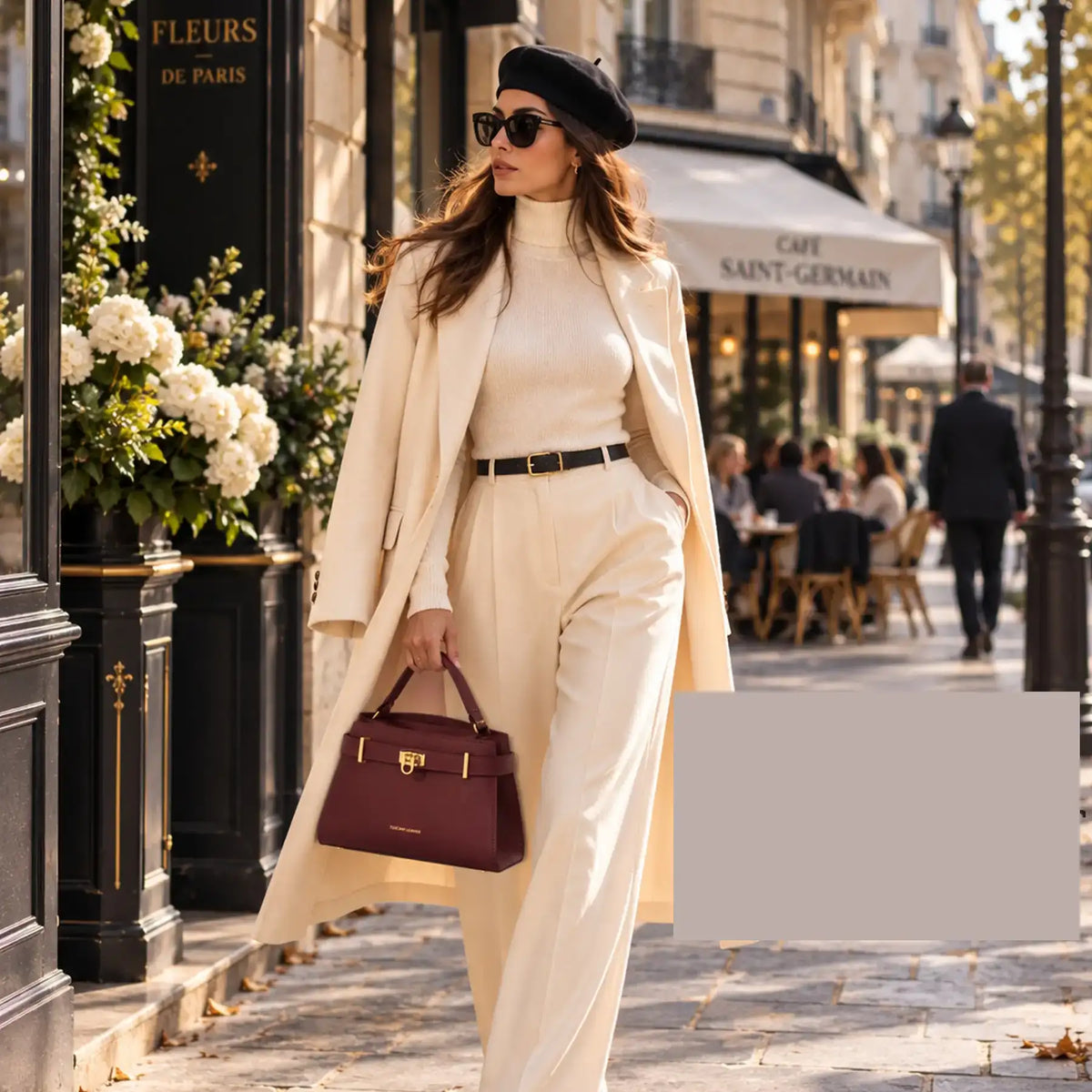
Carrying a structured handbag by its top handle emphasizes the bag's shape and proportions.
This approach is particularly attractive with tailored trousers, dresses, and sharply cut jackets.
It also allows the hardware and flap construction to remain prominently visible.
Shoulder Carry
An adjustable shoulder strap provides an alternative to carrying the bag by hand.
The preferred length depends on the wearer's height, proportions, and clothing.
When adjusting the strap, consider where the bag rests against the body and whether the contents remain easy to access.
Crossbody Styling
A crossbody strap allows the handbag to be carried diagonally across the torso.
This can leave the hands free while distributing the bag's weight differently from top-handle carry.
Comfort depends on the strap length, width, bag weight, and individual fit.
A detachable strap offers flexibility without requiring a completely different handbag.
How to Choose the Right Structured Handbag Size
A handbag's dimensions provide useful information, but measurements alone do not tell the complete story.
External width, height, and depth describe the outer proportions of the bag.
Interior capacity is also influenced by the shape of the gussets, lining, dividers, and closure construction.
The Armonia measures approximately 9.65 inches wide, 7.09 inches high, and 5.12 inches deep.
Its compact, structured silhouette is suited to carrying selected personal essentials rather than oversized belongings.
When evaluating a handbag, consider the actual dimensions of frequently carried items, including a phone, wallet, sunglasses case, or other accessories.
Also consider the size of the compartment openings, particularly when the handbag has a frame-like construction.
For a bag intended to be carried frequently, weight and strap adjustment deserve attention alongside its appearance.
How to Style a Structured Italian Leather Handbag
A structured handbag introduces a deliberate shape to an outfit, making it particularly effective with restrained clothing and defined silhouettes.
With a Tailored Black Suit
A compact structured bag pairs beautifully with black trousers, a fitted jacket, and a simple top.
The contrast between the handbag's curved edges and the clothing's sharper lines creates visual balance.
A black or deep neutral leather finish can produce a monochromatic look, while a contrasting color introduces a focal point.
With a White Shirt and Denim
A crisp white shirt and well-cut denim provide an understated background for a structured handbag.
Gold-tone hardware and smooth leather bring additional definition to the outfit without requiring elaborate accessories.
Wear the bag by its top handle for a polished finish or use the shoulder strap for a more relaxed arrangement.
With an Evening Dress
A compact structured handbag can work beautifully with a simple evening dress, particularly when the proportions are balanced.
Smooth leather and metallic hardware introduce texture while maintaining a clean appearance.
The top-handle silhouette can be especially attractive when additional jewelry is kept restrained.
With Knitwear and a Long Coat
A structured handbag provides contrast to the softness of knitwear and the fluidity of a long coat.
The defined leather silhouette helps bring shape to layered clothing.
Neutral leather colors coordinate naturally with black, gray, cream, camel, and navy.
Choosing Between Neutral and Colorful Leather
Color can dramatically change the character of a structured handbag.
Black, beige, and taupe emphasize the silhouette and coordinate easily with a wide range of clothing.
Bordeaux and dark blue introduce richer color while retaining a relatively restrained appearance.
Brighter leather finishes create greater contrast and can become the central accessory in an otherwise simple outfit.
Smooth leather is particularly effective in saturated colors because its even surface allows the shape and color to remain prominent.
When choosing a handbag color, consider both the clothing you wear most frequently and how visible you want the accessory to be.
A neutral bag may integrate quietly into a wardrobe, while a stronger color offers a more expressive alternative.
How to Care for Smooth Italian Leather
Smooth leather requires appropriate care to preserve its appearance and reduce avoidable damage.
Before using any leather care product, consult the manufacturer's recommendations for the specific leather and finish.
For ordinary surface dust, gently wipe the handbag with a clean, soft, dry cloth.
Avoid exposing the leather to prolonged direct sunlight, excessive heat, or unnecessary moisture.
If the bag becomes wet, blot excess water gently and allow it to dry naturally at room temperature.
Do not use a hair dryer or place the bag directly beside a heater.
Avoid household cleaning products, alcohol-based solutions, and abrasive materials that may alter the leather's finish.
Leather conditioners and protective products should be used only when suitable for the specific leather and recommended by the manufacturer.
Colored smooth leather may respond differently to cleaning treatments, so always exercise caution.
How to Store a Structured Leather Handbag
Proper storage is especially important for handbags designed to retain a defined shape.
Empty the bag before storing it and remove unnecessary weight from its compartments.
Use clean, soft, acid-free tissue paper or another suitable non-staining material to provide light internal support where appropriate.
Avoid overstuffing, which may place pressure on seams or alter the silhouette.
Store the handbag upright when its construction permits and keep it away from direct sunlight and excessive humidity.
Use a breathable dust bag to protect the leather from dust and unnecessary contact with other accessories.
Do not store leather handbags for extended periods in airtight plastic packaging, which may trap moisture.
Detach or position shoulder straps carefully to prevent prolonged pressure marks against the leather surface.
These simple precautions can help preserve both the material and the bag's structured appearance.
What to Look for in a Well-Made Leather Handbag
When choosing a leather handbag, examine more than its exterior appearance.
Consider the quality and suitability of the leather, the accuracy of the stitching, and the way panels align.
Check how smoothly the closures operate and whether the handle and strap attachments appear securely constructed.
Interior organization should suit the items you intend to carry.
For structured designs, inspect the proportions and how well the bag retains its intended silhouette.
Edge finishing, lining, hardware, and the construction of the base all contribute to the overall impression.
A beautiful handbag is the result of many individual decisions working together, rather than one material or design detail alone.
The Appeal of Italian Leather and Structured Design
A structured leather handbag brings together the precision of design and the character of a natural material.
Its success depends on proportion, leather selection, carefully constructed panels, secure hardware, and an interior designed for practical use.
Box-smooth calfskin provides an especially attractive surface for this kind of design, emphasizing clean lines and sculptural curves.
Made in Tuscany from vegetable-tanned leather, the Armonia handbag offers a compelling example of these qualities, with its distinctive flaps, gold-tone twist locks, dual compartments, and versatile carrying options.
For those who appreciate beautiful materials and strong silhouettes, the structured Italian leather handbag remains an appealing expression of personal style.
View the Armonia Italian Leather Handbag | Box Smooth Leather
Style Without Borders™

