




Few phrases in fashion evoke craftsmanship and refinement as readily as “Italian leather.” It suggests beautiful materials, accomplished makers, thoughtful design, and an object created with attention to detail.
This reputation was not created by one designer, fashion house, or moment in history. It developed over generations through the combined knowledge of tanners, pattern makers, cutters, leather artisans, metalworkers, designers, and specialized workshops.
Over time, Italian leather bags came to be widely regarded as an international benchmark. Their influence is not defined by one particular look, but by an approach that brings beauty, functionality, material knowledge, and skilled construction together.
A Reputation Built Over Generations ✦
Italy’s reputation for leatherworking has deep regional roots. Specialized knowledge developed in communities where techniques were practiced repeatedly, refined over time, and shared between generations.
Tuscany became particularly associated with tanning and leather goods. Florence and the surrounding region developed into important centers of craft, commerce, fashion, and production. Other parts of Italy established their own leather, footwear, textile, hardware, and manufacturing specialties.
These traditions did not remain fixed in the past. Workshops adopted new machinery, testing methods, production systems, and technologies while preserving the judgment that comes from understanding leather by sight and touch.
That continuity allowed Italian leatherworking to evolve without losing its connection to the people and places that shaped it.
Beauty and Function Became One Idea ✦
A defining feature of Italian design is the belief that useful objects can also bring beauty into everyday life.
A handbag is not simply a container. Its shape determines how it sits against the body. Its handles affect how comfortably it can be carried. Its closure changes how easily the owner can reach inside. Its proportions influence whether it appears polished, relaxed, modern, or timeless.
Italian design became known for treating these practical choices as essential parts of the object’s visual identity.
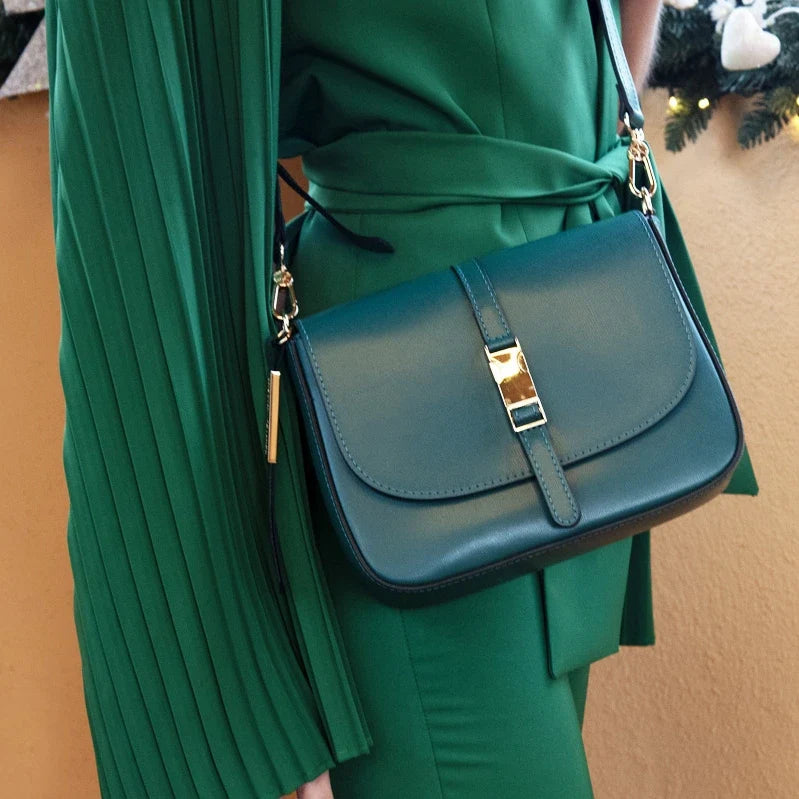
A seam can provide structure while creating a defining line. A clasp can secure the bag while functioning as jewelry. A handle can distribute weight while completing the silhouette.
In this approach, form and function do not compete. Each strengthens the other.
Material Knowledge Shaped the Design ✦
Leather is a responsive material. It stretches, folds, softens, and changes according to its thickness, tannage, grain, finish, and use.
Designing well with leather requires an understanding of how the material will behave after the bag leaves the workshop. A leather that works beautifully for a relaxed shoulder bag may not provide the right support for a structured top-handle design.
Italian leather production developed within regional networks where tanners, designers, cutters, makers, and manufacturers could contribute different forms of specialized knowledge.
This proximity allowed the design to respond to the material. Instead of forcing every leather into the same construction, experienced makers could choose the material and techniques appropriate for the intended silhouette.
That understanding is one reason many Italian leather bags feel considered from the first touch. The leather does not simply cover the shape; it helps determine it.
Regional Production Created Specialized Expertise ✦
One of Italy’s manufacturing strengths is its network of specialized producers and small-to-medium businesses.
Creating a leather bag may involve the expertise of a tannery, pattern maker, cutting specialist, sewing workshop, hardware producer, edge finisher, and quality-control team.
Individual workshops often develop highly specific skills. One may specialize in structured construction, while another works primarily with soft bags, woven leather, hand finishing, or complex edge treatments.
This concentration of complementary knowledge allows quality to be considered at every stage. It also creates a productive relationship between traditional craft and modern manufacturing.
Postwar Italy Redefined Modern Design ✦
Italy’s international design reputation expanded significantly in the decades following the Second World War.
As the country rebuilt and industrial production grew, Italian architects and designers explored how imagination, utility, technology, and manufacturing could work together.
Milan became an especially influential center for these ideas. During the 1950s, exhibitions and discussions at the Triennale Milano helped establish industrial design as a discipline connecting aesthetic form with practical function and production.
Italian design became known as more than surface decoration. It was an approach to transforming everyday objects through proportion, material intelligence, technical experimentation, and attention to human use.
Leather goods developed within this same culture. Traditional workshop skills met modern silhouettes, changing lifestyles, new production methods, and an increasingly international fashion market.
Fashion Introduced Italian Leather Goods to the World ✦
As Italian fashion houses expanded internationally, handbags became powerful expressions of their design identities.
A handbag occupied a unique position within fashion. Unlike most garments, it did not need to fit one body size. It could travel easily, be carried frequently, and communicate a recognizable design language through leather, shape, color, stitching, and hardware.
The international visibility of Italian fashion helped associate Italian leather goods with sophisticated design and skilled construction.
It also drew greater attention to Italy’s broader network of regional workshops, material specialists, independent makers, and manufacturers. The reputation belonged not only to the name on a bag, but also to the production culture behind it.
Restraint Became a Form of Luxury ✦
Italian design is capable of dramatic form and expressive color, but some of its most influential leather goods are defined by restraint.
A clean silhouette places greater emphasis on proportion, leather, stitching, edge finishing, and balance. When ornament is limited, every construction decision becomes more visible.
This approach helped strengthen an idea of luxury that did not always depend on obvious decoration. Quality could be communicated through the feel of a handle, the curve of a gusset, the movement of a clasp, or the way a bag maintained its shape.
This quieter design language has influenced the wider luxury market, particularly among customers who value material quality and understated construction.
Italian Design Also Made Room for Personality ✦
The Italian influence on handbag design is not limited to minimalism. Italian designers and makers have also explored vibrant color, sculptural hardware, unusual proportions, woven surfaces, and playful details.
This combination of technical discipline and creative confidence expanded what a beautifully made leather bag could be.
A design could be bright, soft, architectural, or experimental while still demonstrating careful construction. Tradition became a foundation for creativity rather than a restriction.
That balance between discipline and imagination remains one of the most recognizable characteristics associated with Italian design.
Craft and Industry Learned to Work Together ✦
Italian leather production has continued to develop through the interaction of artisanal knowledge and modern technology.
Machinery can improve precision, consistency, testing, and efficiency. Human judgment remains essential when selecting leather, positioning a pattern, shaping a handle, finishing an edge, or inspecting the final piece.
The strongest production does not treat craft and innovation as opposing forces. Technology supports the maker, while the maker’s experience guides how technology is used.
This approach has allowed Italian leather bags to respond to contemporary needs while preserving the material knowledge that gives them character.
“Made in Italy” Became a Global Signal ✦
Over time, “Made in Italy” became internationally associated with quality, design, innovation, and tradition.
The phrase often carries expectations about more than geography. Customers may associate it with thoughtful materials, specialized production, careful finishing, and an established culture of design.
Those expectations make transparency particularly important. Italian leather, Italian design, and Italian manufacturing are related ideas, but they do not mean exactly the same thing.
A bag can be made from Italian leather without being manufactured in Italy. A product can be designed in Italy but assembled elsewhere. A trustworthy retailer should clearly explain where the leather was produced and where the finished bag was cut, stitched, and assembled.
Protecting the Italian reputation requires protecting the meaning behind the label.
How Italian Leather Goods Influenced the Market ✦
The influence of Italian leather goods can be seen throughout the international handbag market.
Structured top handles, refined totes, elegant crossbody bags, woven leather, sculptural clasps, polished edges, and rich natural colors have all become familiar parts of global bag design.
Italian leather goods also helped bring greater attention to material, construction, origin, and longevity. These qualities increasingly became part of the conversation about what makes a bag worth owning.
Even when a contemporary bag is not made in Italy, its design may reflect principles that Italian leatherworking helped bring to international prominence: proportion, function, material intelligence, and close attention to finishing.
The Standard Is More Than a Label ✦
No country has a monopoly on excellent leatherwork, and an Italian label alone cannot guarantee that every bag is exceptional.
Italy became widely regarded as a benchmark because of its established ecosystem of knowledge: material specialists, designers, craftspeople, workshops, manufacturers, schools, trade districts, and institutions committed to preserving and advancing the work.
The true standard is revealed in the finished piece. It can be seen in balanced proportions, appropriate leather, reinforced stress points, precise stitching, carefully finished edges, functional hardware, and a design that remains useful after a trend has passed.
Authentic excellence must be demonstrated through materials and workmanship—not assumed from a country name alone.
Why the Influence Continues ✦
Italian leather design remains relevant because it has never depended solely on preserving the past.
New generations of designers and makers continue to explore lighter structures, contemporary functions, responsible production, traceable materials, new colors, and changing ideas of luxury.
At the same time, the fundamental questions remain familiar: Does the object function beautifully? Does the material suit the design? Has it been made with care? Will someone still want to carry it years from now?
This combination of continuity and experimentation allows Italian design to evolve while remaining connected to its heritage.
A Legacy Carried Into the Future ✦
Italian design came to be regarded as a gold standard for leather bags through the accumulated work of many generations.
Tanners learned to reveal the character of the material. Artisans refined the details of construction. Designers transformed practical needs into elegant forms. Workshops and manufacturers carried those ideas into an international market.
Together, they established an expectation that a leather bag could be practical, expressive, beautifully made, and enduring at the same time.
That may be the most important Italian influence of all: the belief that an everyday object deserves imagination, expertise, and care.